.png)
Does your child cover their ears when the vacuum turns on, avoid certain clothing textures, constantly seek movement, or become fascinated by lights or spinning objects?
These experiences may relate to sensory processing—the way the brain receives, organizes, and responds to information from the senses. Sensory differences are common among children with autism, but they can look very different from one child to another.
Some children are highly sensitive to particular sensations, while others seek additional sensory input. A child can even be sensitive to one type of input while actively seeking another.
Understanding your child's sensory preferences and challenges can make everyday routines easier to navigate and help families choose appropriate supports and sensory activities for autism.
At My Favorite Therapists, we believe understanding the individual child—including how they experience and respond to their environment—is an important part of helping them develop meaningful skills.
Key Takeaways
- Sensory processing describes how the brain receives, organizes, and responds to sensory information.
- Children with autism may be hypersensitive to certain sensations, hyposensitive to them, or actively seek particular sensory experiences.
- Sensory differences can involve sight, sound, touch, movement, body awareness, taste, and smell.
- A child's sensory preferences can affect play, eating, dressing, transitions, learning, and other daily routines.
- Sensory play can be enjoyable and may provide opportunities to develop play and fine motor skills, but activities should be selected based on the individual child.
- Occupational therapists commonly assess sensory processing when it interferes with everyday functioning.
- Sensory strategies should have a clear purpose and be monitored to determine whether they actually help the child participate more successfully.
What Is Sensory Processing?
Sensory processing is the way our nervous system takes in information from our bodies and surroundings and helps us respond to it.
Most people think first about the five familiar senses: sight, hearing, touch, taste, and smell. Two additional systems are especially important when talking about children's development:
Vestibular processing relates to movement, balance, and the position of the head.
Proprioception provides information from muscles and joints that helps us understand where our body is in space and how much force we're using.
For most people, these systems work together throughout the day without much conscious thought.
For some children, however, particular sensations can feel unusually intense, difficult to notice, distracting, or highly interesting.
How Does Sensory Processing Present in Autism?
Sensory differences are recognized as part of the diagnostic criteria for autism spectrum disorder. A child may demonstrate hyperreactivity, hyporeactivity, or unusual interest in sensory aspects of their environment.
Hypersensitivity
A hypersensitive child may experience certain sensory information more intensely.
For example, they may:
- Cover their ears around hand dryers or vacuum cleaners
- Become distressed in noisy or crowded places
- Resist haircuts, toothbrushing, or nail trimming
- Avoid particular clothing fabrics or tags
- Refuse foods because of texture, smell, or temperature
- Dislike getting their hands messy
- Become overwhelmed by bright lights
Hyposensitivity or Sensory Seeking
Other children may respond less strongly to certain sensory information or actively seek more intense input.
You might notice a child:
- Constantly jumping, climbing, or spinning
- Crashing into cushions
- Touching many objects
- Seeking tight hugs or pressure
- Watching spinning objects closely
- Making repetitive sounds
- Seeking strong tastes, textures, or smells
Neither pattern tells you everything about a child. Sensory responses can vary by environment, activity, time of day, and sensory system.
The Sensory Systems Parents Should Know
Visual
Visual processing involves information we receive through sight.
A child might be sensitive to fluorescent lighting, busy rooms, or visual clutter. Another child might be especially interested in bright lights, moving objects, patterns, or watching objects from unusual angles.
Auditory
Auditory processing involves sound.
Common household noises such as a blender, vacuum, hair dryer, or toilet flushing may be uncomfortable for some children. Busy restaurants, birthday parties, and classrooms can also create a large amount of competing sound.
Tactile
The tactile system relates to touch.
Children may react strongly to clothing, food textures, grooming, sand, grass, sticky materials, or finger paints. Others may actively seek tactile experiences.
Vestibular
The vestibular system helps with balance and movement.
Some children seek swinging, spinning, bouncing, or climbing, while others may be hesitant about playground equipment, stairs, or having their feet leave the ground.
Proprioceptive
Proprioception helps us understand body position and movement through information from muscles and joints.
Activities involving pushing, pulling, carrying, climbing, or other forms of “heavy work” provide proprioceptive input.
Signs Parents May Notice at Home
Sensory differences don't always appear during obvious “sensory activities.” They often show up during ordinary family routines.
You might notice difficulty with:
- Getting dressed
- Toothbrushing
- Hair washing or haircuts
- Mealtimes
- Busy stores
- Birthday parties
- Riding in the car
- Bedtime
- Transitioning between environments
- Playing on playground equipment
- Messy play activities
For example, what initially appears to be resistance to getting dressed could involve discomfort with a particular fabric or tag. Difficulty eating certain foods might relate partly to texture, temperature, smell, or taste.
Understanding possible sensory factors can help parents and clinicians look beyond the behavior itself.
Sensory Activities for Autism: Finding What Works for Your Child
There is no single list of sensory activities for autism that will be appropriate for every child.
The benefit of sensory play depends on the individual child's preferences, needs, abilities, and goals.
Some children may enjoy activities such as:
- Playing with water
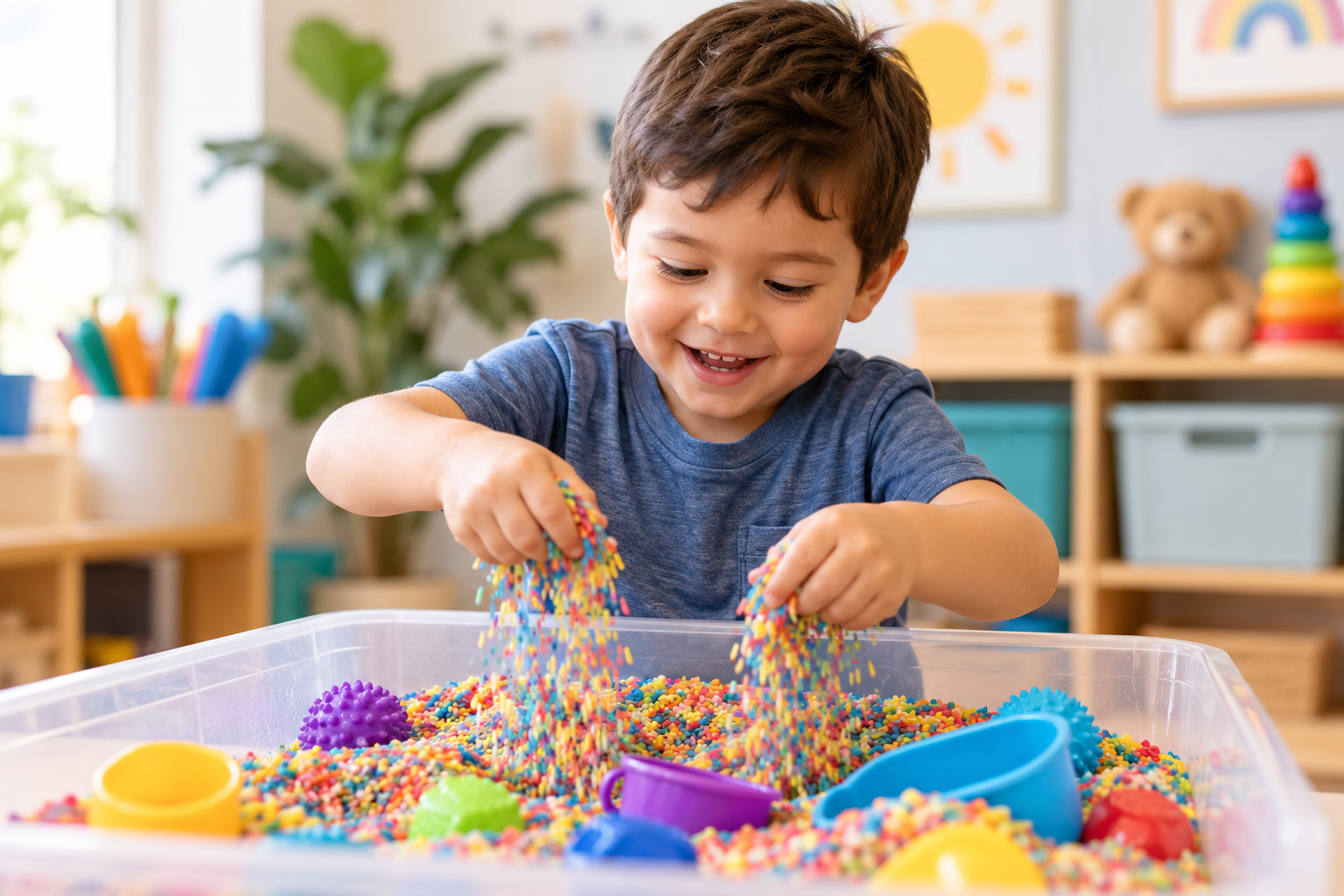
- Scooping dry rice, cereal, or pasta in a sensory bin
- Playing with play dough
- Using finger paints
- Dancing to music
- Jumping or climbing
- Playing with bubbles
- Digging in sand
- Pouring and measuring
- Pretend cooking
- Carrying or pushing age-appropriate objects
Activities that involve squeezing, scooping, pinching, pouring, and manipulating small objects can also provide opportunities to practice coordination and fine motor skills.
Parents sometimes make colorful sensory materials using food coloring, but remember that sensory materials should always be age-appropriate and carefully supervised.
Small objects and products such as water beads can present serious ingestion and choking hazards and should not be treated as universally appropriate sensory toys for young children.
Starting Small With New Sensory Experiences
If your child avoids a particular texture or experience, forcing prolonged exposure can create additional distress.
Instead, consider starting small.
A child who dislikes finger paint, for example, might begin by using a paintbrush or sponge rather than putting their hands directly into the paint.
You can encourage your child to explore without making participation a battle.
Likewise, a child who finds busy environments overwhelming may benefit from shorter visits, quieter times of day, predictable routines, or access to a calmer space.
The goal isn't necessarily to make a child tolerate every sensation. Sometimes the most effective strategy is simply modifying the environment so the child can participate comfortably.
Creating a Sensory-Friendly Environment
Supporting sensory needs doesn't always require specialized equipment.
Simple strategies may include:
- Reducing unnecessary background noise
- Dimming harsh lighting when possible
- Creating a quiet space for breaks
- Preparing children before entering noisy environments
- Using predictable routines
- Offering clothing without irritating tags or seams
- Providing movement opportunities throughout the day
- Allowing appropriate sensory tools when helpful
Pay attention to what happens before, during, and after a sensory experience.
Does an activity help your child participate in the next routine? Does it seem enjoyable? Does it increase distress? Does it make transitions easier?
Those observations are more meaningful than simply following a generic list of sensory activities.
How Are Sensory Needs Addressed Clinically?
When sensory differences interfere with a child's ability to participate in everyday life, an occupational therapist may evaluate sensory processing along with areas such as fine motor skills, motor planning, feeding, self-care, and daily activities.
Occupational therapy goals should be individualized around meaningful participation and independence.
For children also receiving ABA therapy, the care team may consider sensory preferences when designing the environment, selecting reinforcers, teaching communication, or understanding behavior.
For example, applied behavior strategies might help a child learn to appropriately request “break,” “quiet,” or “all done” when an environment becomes overwhelming.
At My Favorite Therapists, multidisciplinary pediatric therapy can help families look at the whole child and develop individualized strategies for communication, independence, play, learning, and participation in everyday routines.
What Is a Sensory Diet?
Despite the name, a “sensory diet” has nothing to do with food.
The term is commonly used to describe an individualized schedule or collection of sensory activities intended to help a child regulate and participate in daily activities.
A sensory diet might include planned opportunities for movement, pushing or pulling activities, quiet breaks, or other sensory experiences.
However, parents should avoid assuming that a generic sensory diet found online is appropriate for their child.
The American Academy of Pediatrics has noted that evidence for sensory-based therapies is limited and inconclusive. When sensory strategies are used, families and clinicians should establish specific goals and monitor whether the intervention actually improves the child's ability to participate in everyday activities.
Frequently Asked Questions
1. Is Sensory Processing Disorder the Same as Autism?
No. Sensory differences are common in autism, but they are not exclusive to autism. The AAP notes that sensory difficulties can occur with several developmental and behavioral conditions. Sensory Processing Disorder is also not recognized as a separate diagnosis in the DSM-5.
2. What Are Common Signs of Sensory Sensitivities in Autistic Children?
Signs can include covering the ears around certain sounds, avoiding particular food or clothing textures, discomfort with grooming, strong reactions to lights or smells, or avoiding certain movement experiences. Other children may actively seek movement, touch, pressure, sounds, or visual input.
3. Can Sensory Sensitivities Improve Over Time?
A child's responses and ability to manage different environments can change as they develop and learn new skills. Rather than focusing solely on eliminating sensitivities, support may include accommodations, communication strategies, environmental modifications, and individualized therapy when needed.
4. What Is a “Sensory Diet”?
A sensory diet is a planned set of sensory experiences or activities intended to support participation and regulation throughout the day. It should ideally be individualized around the child's specific needs and functional goals rather than taken from a generic online list.
5. How Can Parents Support Sensory Sensitivities at Home?
Start by observing what your child appears to seek or avoid. Reduce unnecessary sensory stressors, create predictable routines, provide breaks, and offer safe sensory experiences your child enjoys. If sensory differences significantly interfere with eating, dressing, sleeping, learning, play, or other daily activities, discuss your concerns with your pediatrician or an occupational therapist.
Understanding Your Child's Sensory World
Sensory differences are only one part of a child's experience, but understanding them can give parents valuable insight into why certain environments, routines, and activities may be easier or more challenging.
The goal isn't to eliminate every sensory preference or create a packed schedule of sensory activities.
Instead, focus on helping your child feel comfortable enough to communicate, play, learn, build independence, and participate in everyday life.
For some families, that means adjusting the environment. For others, it may mean occupational therapy, communication support, ABA therapy, or collaboration among several professionals.
By observing your child's individual responses and working with qualified professionals when needed, you can build routines and experiences that support both development and participation.